Showing posts with label Mulligan. Show all posts

Wednesday, February 11, 2009

James Joyce's Ulysses, Telemachus No. 26


[Cf. 1922 5:20-27, Gabler 1:86-94]

We get an important glimpse of Stephen here, as we learn that he refused to pray for his mother at her deathbed. What kind of a**hole doesn't obey his dying mother's wish to pray with her? Discuss.

I mean, yes, Stephen is an Artist of Profound Integrity, who cannot compromise his belief in his unbelief. And yes, we are meant to think of him as kin with Hamlet, with Telemachus, with those who fight to leave behind their lives as boys to become men. And I even think that we are meant to pity Stephen more than a little, who has become so alienated through his extremism.

Mulligan refers to himself and Stephen as "hyperborean." What does this mean? Gifford gives us the basics--it's a classical allusion, to a kind of perfectly youthful master race who lived at the far ends of the earth. More specifically, Gifford pegs the reference to Nietzsche & a passage in The Will to Power, wherein the Ubermensch were described as hyperborean, as beyond the constraints of conventional morality, especially Christian morality.

Anyone out there have more to say about hyperborean? About Stephen's refusal to submit and what we're supposed to think about it?

I love the bottom panel here... Mulligan looking stately and plump indeed, beautifully framed and posed like he's about to start shooting lasers out of his hands. Which would make things interesting. His pose, his position, his framing, all speak together with the authority of Mulligan's perfectly reasonable criticism of Stephen. And Stephen knows it, but he doesn't care.

Sunday, February 1, 2009

James Joyce's Ulysses, "Telemachus" No. 25

[cf. 1922 5.18, Gabler 1.85]

First of all, have you found us on Facebook yet?   Yet another in our growing arsenal of tools to bring this strange project to the world.

As I write it's the old man's birthday in Ireland. An auspicious day for a man who tended to be superstitious about the calendar. And as our subject we have a rather glorious image, and we're talking about mothers.  What's could be more appropriate?

A moment ago, Mulligan was quoting Swinburne when he referred to the sea as our "great sweet mother."  He's modulated into George William Russell a/k/a AE, who often referred to nature as the Mighty Mother.  Russell was a preeminent literary figure in turn of the century Dublin, and in 1904 he became the first person to publish a short story by Joyce--in a newspaper he edited called The Irish Homestead.  Russell has a prominent part in Episode 9--"Scylla and Charybdis"--and we'll certainly talk more about him then.

Back here in "Telemachus, Mulligan's comment will lead, a moment from now, into a discussion of Stephen's mother's death.  There's a lot to be said about the different roles of mothers and fathers in Joyce's world--especially in Episode 9.  Very briefly--mothers are associated with ultimate, undeniable truth--truth beyond language.  They may be the one true thing in life (a paraphrase). Paternity, however--especially in the days before genetic testing--was uncertain.  This uncertainty creates an intolerable vacuum, that has to be cemented over with legal, verbal certainties. In "Scylla," Stephen talks about paternity as a "legal fiction," (and you should put as much emphasis on the fiction as on the legal here).  You should also be thinking about Hamlet again, and always!


Sunday, December 21, 2008

James Joyce's Ulysses; Telemachus, No. 22


[Cf. (1922, 4:1-21), (Gabler 1:34 -49)]


As promised, we move forward a little faster by doing a full page at a time.


We've talked already about Stephen as "Daedalus", master builder and what not, but Rob's first drawing on this page is a great reminder that Stephen is in a labyrinth.

Mulligan points the way to the association with his riffing on Stephen's absurd Greek name. Why is Mulligan talking about the Greeks, anyway? I'm sure part of what's going on is Joyce signalling to the reader that we are both in Homer's Greece and and in Joyce's Ireland at the same time. Mulligan's interest in Greek also marks his superior education, and for a few brave interpreters, suggests that he may be gay.

Stephen is an artist, and he's looking for direction. For many Dublin artists, the logical place to go was London--that's where the publishers and readers were, that was where the roots of English literature were planted, that was where the money was. In 1904, with a great Celtic awakening in full swing in Ireland, many artists were looking instead to the island's native culture--think of John Millington Synge, or of Miss Ivors' cutting remarks to Gabriel Conroy in "The Dead." Mulligan proposes a third way--looking to the traditions of the ancient world, and past the less-culturally-stimulating history of the Roman empire to the world of the Greeks.

Many articles have and will continue to be written on this subject, but for now, let me put in a small placeholder to indicate that that the concept of the classical world was very important for all kinds of "modern" artists--advances in archaeology in the late nineteenth century made that world suddenly far more real, and many artists of the period looked to the classical world for a purity and humanism in art that would get them past what was seen as the decadence and chauvinism of the late Victorian period. This trend is the very place Ulysses comes from, after all. [Tho' on this, another brief note--Joyce himself did not know much ancient or modern Greek. He sure knew his Latin, though!]

One would expect that Stephen would be more sympathetic to Mulligan's invitation, then. But Mulligan's invitation, we will see, is utterly insincere. And also, Telemachus doesn't go back to Troy to find his father...

Wednesday, December 10, 2008

James Joyce's Ulysses, No. 21

[Cf. 1922, 3:26-27; Gabler 3:28-29]

And so, patient readers, we arrive at the bottom of the first page of the 1922 Ulysses.  I promise we will pick up the speed a little bit as we move ahead--we're just getting used to this way of working! 

Since we are moving at such a stately, plump pace, however, I get to notice a few things I would normally pass over.  Like Mulligan switching off the current here.  Over the last few weeks I've said a lot about the little transubstantiation magic trick that Mulligan is doing here.  But this time, Mulligan's electricity reference struck me...  I've always read this as Mulligan making a reference to some kind of medical experiment he would have seen as a student, a la Frankenstein


Looking around the web, I found a nice piece of trivia--the Pigeon House, the famous unreached destination of Joyce's short story "An Encounter," began it's long life as an electricity power station in 1903, only a year before the events in the tower are supposed to happen.  The Poolbeg Station now surrounds the original Pigeon House, and is easily visible from the top of the Joyce tower [It also plays a starring role in U2's "Pride (in the name of love)" video.]

The first power station in Dublin was opened in 1892.  Clearly the tower doesn't have electricity.  A gas lamp gets a speaking part later on in the book, and Stephen and Bloom eventually have a conversation about electric vs. gas streetlams--I'll look forward to tracking electricity references from here...

Sunday, November 9, 2008

James Joyce's Ulysses, Telemachus, No. 16


[Cf. 1922; 3:22; Gabler; 3:24]

Mulligan is performing a little trick here at a critical moment in his parody of the mass. He knows that there's an echo from the top of the tower (never checked this out myself), so he's putting it to work at a moment that parallels the epiclesis, the moment when the presence of God is summoned into the communion wine and bread.

Joyce doesn't give a sound for Mulligan's whistle--only that it's a "long slow whistle of call," like the way you'd whistle to a dog, or the hot dog guy. There's something a little lascivious about the way Rob has drawn Mulligan's face and fingers here, which is all part of the picture too...

Wednesday, October 22, 2008

Ulysses, Telemachus, No. 14


[Cf. 1922; 3:17, Gabler 3:19]

Rob and I had a long conversation about this passage and what Buck means when he says "back to barracks." I see it as a garden-variety transubstantiation joke--wherein Mulligan is trying to keep the genie in the bottle, the spirit of Christ (or "christine," as Mulligan will say in a moment) from escaping the shaving bowl before it can be [insert precise verb here] into the shaving lather.

I'm bracketing the verb here because as I have been reading the above-linked Wikipedia post about transubstantiation, I see that the choices I was about to make (mixed, infused, combined, blended) are all wrong and invoke heresies. [side-side point. I am glad I am not a proper academic, because if I was, I would have to scorn Wikipedia. It's a little lazy for me to link to Wikipedia so many times, but it's good information, in most cases better than what you get in Gifford & Seidman (forgive me, Don & Robert. You would love Wikipedia.).

Reading through the entry, I can't help but think of Stephen's little aesthetic dissertation on perception and essence in Portrait, and the whole Aristotelian Fugue-state he enters in Proteus. [as long as I'm making these little side notes, a little David Foster Wallace homage, the fugue state idea reminds me that Proteus would be a good place to talk about Stephen as an Aspie avant-la-lettre. {OK. one more. I swear. If you followed the Aspie link, you saw that one of the "you may be an aspie" jokes was if you know the historical derivation of the word "trivia." Famous Joyce quote: when asked if he was worried that people would consider some of the puns in Finnegans Wake "trivial" he said "yes, and some are quadrivial." There you go.}]

But I trigress. or quadgress.

About the barracks. It's important to know that in the Dublin mind, a "barracks" is not an abstract or alien thing at all. In 1904, as at many times in Irish history, British troops were garrisonned in barracks that were cheek and jowl with densely populated urban neighborhoods. Because their function was to control the people living in those neighborhoods. Think Baghdad's Green Zone. Despite the comparison, this is not the way US citizens tend to think of military bases. The presence of British troops on the street, their movements, their leisure entertainments, their interactions with the "natives," are all an important part of the atmosphere of Joyce's Dublin in June of 1904. These days, the old barracks have been appropriated for various purposes... the now-called "Collins Barracks" is a stunning museum, part of the National Museum of Ireland, with exhibitions relating to decorative arts and Irish history. The barracks at "Beggars Bush" has a national printing museum.

Monday, October 13, 2008

Ulysses, Telemachus, No. 12


Cf. 1922, 3:10-11; Gabler 3:11-12

At last, we meet Stephen. Mulligan approaches him like he’s the antichrist. He is not amused.

As the two men carry on their conversation at the top of the tower, these drawings make the contrast between them much more apparent. I love, too, how the top of the tower looks like a bull ring. Stephen will soon be called the “bullock-befriending bard,” though his pose is more that of the toreador here. I also can’t help but think of Spy vs. Spy, the old Alexander Prohais comic from Mad Magazine.

Thursday, September 25, 2008

Ulysses, Telemachus, No. 8


[Cf. 1922 3:7, Gabler 3:8]

Mulligan calls down to Stephen (whom Mulligan has nicknamed "Kinch") to join him at the top of the tower. Why does he call Stephen "fearful"? Probably because of an incident that happened during the night with a house visitor--we'll be hearing about that soon. But also because of Mulligan's blasphemy, which we've been chatting about over the last few frames. Stephen isn't a believer, but he's not above hedging his bets.

Oliver St. John Gogarty, the person on whom the character of Mulligan is based, once referred to Joyce as an "inverted Jesuit." Joyce identified closely with the Jesuit order--he was educated in Jesuit schools as a boy, and in one famous anecdote, said "you allude to me as a Catholic; you ought to allude to me as a Jesuit" (see Kevin Sullivan's Joyce among the Jesuits for an exhaustive discussion). The Society of Jesus, then and now, has been closely associated with education based on rigorous and independent scholarship. Mulligan's 'fearful Jesuit' may also pick up on the dreaded reputation of Jesuits as interlocutors.


Saturday, September 20, 2008

Ulysses, Telemachus, No. 7


[cf. Gabler 3:5, 1922 3:5]

Let's get right to what you need. Mulligan is tawkin' Latin. What he's saying translates as: "I will go up to God's altar." More pertinently, it was one of the first things the priest said at the beginning of the Catholic mass, back when the Catholic mass was said in Latin.

So yes, Mulligan's giving a little parody of the mass, and yes, this is a wicked and kinda funny thing to do.

I think it's worth noting a few points of cultural context. 1) the "introibo" would not have been an obscure phrase to any Catholic reader of Ulysses in 1922, or up to the end of the Latin mass in the 1960's. This would have been as familiar as "play ball!" to a baseball fan. 2) to a Catholic audience, in 1904 or 1922, this is sacrilege. And what follows is much worse.

What we're supposed to think of this is a little hard to say. What Joyce thinks of it we don't know, but (within the fourth wall) what Stephen thinks of it, we'll see later. Joyce was an unbeliever, but the Catholicism was so deeply dyed into him, that he was really more Catholic than the Catholics. The groundwork is all so elaborately laid out in *A Portrait of the Artist as a Young Man* that it seems superfluous to talk any more about it, but I'll say for the first time of many times, that Joyce was not Stephen. it can be useful to forget that Joyce was not Stephen, but still and forever, they are not the same.

Finally, remember Mulligan is the usurper. How does this bit of mockery add to that reputation?


Tuesday, September 16, 2008

Ulysses, Telemachus, No. 6


[cf. Gabler 3:2; 1922 3:2]

Having had the bird's eye view in the last frame, we pull in to see what Mulligan is carrying: "a bowl of lather, on which a mirror and a razor lay crossed." On one level, a man is simply about to shave. But Joyce's careful syntax invites a deeper dive. Mulligan is about to begin chanting the opening prayer of the Catholic mass, and the visual cues Robert's been giving us have primed us to see him as a kind of priest. But here, for the moment, we get to look at Mulligan's tools: a mirror, and a razor. The razor cuts and makes distinctions--hair from skin, mostly (analysis?). The mirror reflects an image, sends back to its viewer the appearance of a person where before there had only been a disembodied experience of impressions and thoughts (synthesis?). [And yes, I'm thinking about Jacques Lacan and his "mirror stage" here.] Neither the mirror nor the razor creates anything really new. This is the opposite of what is supposed to happen during a real mass, when the priest uses his tools and the magic of transubstantiation to bring the body and blood of Christ to the table.

Yeah, I'm pushing it a little hard here, but I do think we're meant to see Mulligan as energetic and vital, but also as bankrupt, as barren, as a parasite. Dedalus is weak and ineffectual, but he has the creative vitality and inner strength that Mulligan lacks.

PS: It's really hard for me to see this book the way new readers see it. It's impossible to 'unlearn' everything I know about these characters and their fictional city. I will try to be careful to respect the virginity of new readers and not give too much away or base readings on things a new reader can't possibly know (because they haven't come up in the book yet). ... but I'm going to fail. I know that already.


Thursday, September 11, 2008

Ulysses, Telemachus, No. 5


Rob's drawing gives us an intriguing birds-eye view that conveys at least two important pieces of information: a) we're out in the middle of nowhere, and b) Mulligan is putting on a show without an audience. Not having an audience is intolerable for Mulligan, so he will shortly summon Stephen Dedalus to serve as an altar boy to his perverse shaving mass.

Let us say something obvious. Living in an unheated Napoleonic fortification, 7 1/2 miles from the center of town as the crow flies, is not a practical decision.
It's exactly the sort of decision that a bunch of 20-something guys make. Before they get girlfriends. Or boyfriends. And Mulligan is totally living the dream, making the most of his tower by the sea--or he's trying to.

And one more obvious thing--there's a practical reason Mulligan comes to the top of the tower to shave. It's very dark and smoky in the living quarters below, not to mention the heady aroma of one rather unclean Dedalus (more on that later) and a sleeping Englishman.


Sunday, September 7, 2008

Ulysses, Telemachus, No. 4


Mulligan has emerged from the staircase, and we spend a few moments, a few images, getting our bearings on the top of the tower. I'll say more about the little doorway in a future post, but for now, I'm spending a moment on Mulligan's robe. You can't tell from this black & white, but he's wearing a yellow robe--a yellow dressinggown.

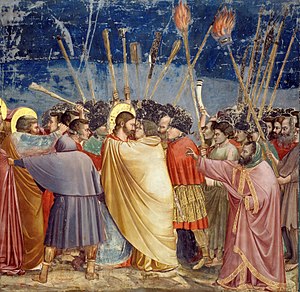
Why yellow? Don Gifford & Bob Seidman's Ulysses Annotated might be useful here (as it is throughout the journey. Professor Gifford cites a volume on Christian symbolism: "Yellow is sometimes used to suggest infernal light, degradation, jealousy, treason, and deceit. Thus, the traitor Judas is frequently painted in a garment of dingy yellow (I've been trying to get that picture--which is an image of "The Kiss of Judas" by Giotto-- see below.


I've always thought Mulligan gets a bad rap... and I identify with him in a way. Rather, that whatever it is that makes him so repellent to Stephen must happen "off camera"... in this chapter, he seems a little glib, but more sensible than Stephen. And he's funny...