Thursday, August 28, 2008

Ulysses, Telemachus, No. 2


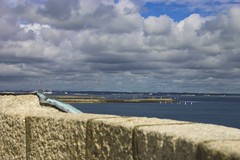
Here's your establishing shot for the first episode of Ulysses.


The first scene takes place in a tower by the sea. The tower is a Martello Tower. It's a real place, and Joyce really lived there for about a week in September of 1904. They were built by the British early in the 19th century, when they feared a French invasion of Ireland. It's now the James Joyce Museum, run by a wonderful guy named Robert (never Bob!) Nicholson. [By the way, if you go to Dublin and ask for the Martello tower, you will get blank stares. There are many Martello towers on the coast of Ireland, especially the southeast coast.][Also, do not confuse the James Joyce Museum with the James Joyce Centre.] The museum is the tower. The Centre is in downtown Dublin & has more going on in terms of programs & activity.]


When I first saw a picture of the tower I was surprised by how stubby it was. Less phallic than you'd think, but not beyond the realm of physiological phenomena.


If you are lucky enough to go to the Joyce Museum and see the view from the top, you'll notice that you have a great view of Dun Laoghaire (pron. "Dunleary") , the primary ferry terminal for Dublin, the primary departure point for voyages from (and to) Ireland. So--a castle overlooking the sea: Hamlet. A castle with a view a port for leaving the island: the Odyssey. And it ties out to a moment Joyce's life, and a moment in Irish history as well. A perfect "overdetermined" multiple overlaying of the personal, the literary, the historical... and we haven't even talked about the religious elements... and we're just getting started!

Monday, August 25, 2008

Ulysses, Telemachus, No. 1


If you know anything about Ulysses, you might know that it bears a strong family resemblance to Homer's Odyssey. Joyce transposes elements of the ancient story to one day in the life of Dublin, a warm June day in 1904. Telemachus is the son of Odysseus (that's Ulysses to you, if you're Roman), and when you meet him, he is desperate to do something about the horde of suitors that is waiting to marry his mother and despoiling his home. He doesn't remember his father, who's been gone for a very long time.

But if you just pick up Joyce's novel, you have no idea that the first episode is called "Telemachus." [Nor, for that matter, do you know that it's June 16, 1904, 8:00 a.m., or a Thursday. It takes hundreds of pages to figure this out. But we bring it to you on a platter!]

"Telemachus" appears nowhere in the book. Joyce had Homeric titles for all of the 18 episodes, however, and he used them regularly when talking about the book with his friends. In 1920, he created a "schema" for his friend (and writer and critic) Carlo Linati, which would quickly become the first of many tools for reading the book.

So why, if Joyce used these titles when writing the book & talking about it with friends, did he not include them? Does he just like messing with us?

Ulysses, Telemachus, Preliminary

And so, gentle reader, we begin. First, some words on procedure. Every few days, we will post one of Rob's drawings here. I'm going to mark up his drawings a little to point out the things I'm going to talk about in my commentary. (If you like the drawings, they'll be available for purchase! Rob will explain how that's going to work.)

For today, I'm talking about the introductory panel for the first episode, Telemachus. Rob's original work looks like this:


And my markup looks like this:


So just so we're clear, the crude spraypainty defacings are mine.

We invite, we encourage, we downright urge you to comment. Your participation is crucial to the success or failure of the project, so please ask questions, give opinions, make funny puns, etc. Stay tuned for the first post!

Wednesday, August 20, 2008

Mike Introscuses Himself!


Hello. This is Mike Barsanti, yr humble interlocutor & sometime Joyce scholar, the Father Cowley of Joyce Scholars, defrocked and voluble. I come to this project dishonestly, having been, at the time it was introduced to me, the Associate Director and "resident Joycean" of the Rosenbach Museum & Library. I am now no longer there, working for a Very Large Philanthropic Organization that will not be named. Yet.


I came to Joyce dishonestly too, not out of any dignified need to experience great art, but rather because I have a competitive streak and I heard it was the hardest book to read in the English language and that my father had started it and never finished. And it was written by an Irishman, and I was much more interested in my Irish heritage (Momma was an O'Rourke) than in my Italian or (Heaven Forfend!) my English heritage. I would later realize that the blend of Irish, Italian, and English was actually an excellent combination to bring to the Joycean altar... but save that for later.

My bona fides, such as they are: First read Ulysses with the great Ed Germain at Andover. Took a class with Don Gifford at Williams, then went to U. Miami (Go 'Canes!) & got an M.A. with Zack Bowen & Pat McCarthy & an amazing rag-tag fleet of Joycan grad students. Very smart people. Took Bernie Benstock's last Finnegans Wake seminar there. Joined the IJJF and went to the best literary academic conferences ever in Seville and Rome and London. Went to U. of Penn. & did my Ph.D. with Vicki Mahaffey (my dissertation adviser) and Jean-Michel Rabate, as well as a great crew of colleagues and friends. Worked at the Rosenbach Museum & Library for 11 years, first as an intern, then a consulting curator, then associate curator, then Director of Special Projects, the Associate Director. Curated the 2000 exhibition *Ulysses in Hand*, which opened at the Chester Beatty Library in Dublin. Curated a traveling exhibition about Joyce and his work for the Irish government that travelled all over the world in 2004. blah-de-blah.


So know, gentle reader, that you are in the hands of a true Joyce Trekkie. Haines says in "Wandering Rocks" that Shakespeare is "the happy hunting ground of minds that have lost their balance." It's not just Shakespeare any more. I'm glad you're joining us for a very strange journey.

Tuesday, August 19, 2008

Okay, we're back...


So, a couple of months have gone by.
Sorry.
The thing is that BloomsDay '08 was the premier and test for this project and, I'm happy to say, it went very, very well. There's been terrific response for the potential of this adaptation and some support offered and we've been taking some time to structure things according to that.
You may notice that I'm saying "we" here instead of "I." In the coming weeks I'll be turning over the majority of this blog to Mike Barsanti, my friend and partner in the project. It's our intention to move this blog into a kind of a production model for annotation of the text through each panel of the comic in the hope that it will make some of the more obscure references a bit more clear. It will also serve that way as a conduit for other Joyce fans to tell me exactly what it is I'm doing wrong (I'm still trying to convince myself that this is a good idea).
I'll leave to Mike to introduce himself, but what you'll be seeing here now is the the black&white drawings of each of the images in my adaptation but with his corrections and comments on subtext; the color commentary, if you will.
In the meantime we'll be starting extra little mailing lists to provide readers with web-blasts for when new material is added to the comic. We've been busy setting up our business end of things and, while there is plenty of new material for another installment, I've been focusing my efforts on scripting (or, in comic parlance, "thumbnailing") through the first three chapters of the novel. As many people have warned me, "'Proteus' is a big hurdle." I knew this going in of course, but I didn't think I'd be forced to prove I can jump it in the time trials. I think I can.
One of the things that makes "Proteus" so difficult is the density and specificity of Stephen's references. Trying to understand them and then relate that understanding to others using visual keys is, let's face it, the lynch-pin of how this project works. It brings up a topic Mike, Josh and I have been discussing for awhile now; whether or not the visual interpretation of the novel we're attempting here can serve as a "roadmap for a hypertext," something that allows annotation to coexist with content. We'll be discussing this more and more with Mike involved, but I'm about thirty pages into "Proteus" now, and I haven't left out a single word of the original text. It makes the production seem dauntingly large, but more and more possible.

Wednesday, June 18, 2008

What's the real beginning?

So the big underlying question here with an established text released in serialized form is, "where to start?"

There are really huge debates to be had here in regard to the definitive text but, according to my assessment it's the 1922 edition of Joyce's work that is most clearly now a part f the public domain and so that was the place to go for my sources.

I'm treading lightly on subjects like this, for obvious reasons, but it seems clear to me that one of the points of current public domain and fair usage laws has something to do with allowing artists to respond to earlier works of art that have, through history and reader involvement, wormed their way into the public consciousness. Joyce's work is iconic. Hans Gabler's is wonderfully, richly-researched and academically exhaustive, a great boon to the readers wishing to understand a text that has had many disturbing permutations, some of them cased by the author himself. But Gabler did not reinvent the novel and it has lived as an iconic piece of fiction for many, many decades before he took up the task of "correcting" it. I'm happy for the things his research has taught me about the novel, but, looking at his contribution as a uniquely new work of art, and therefore re-packaging the existing public domain laws so that the copyright starts over again in 1984 with this "corrected" text completely ignores the life this book has already enjoyed as an individual artistic statement.

There are numerous problems with the 1922 text. That's clear. But this is how the work came into the world, "warts and all," and this seems the best text to represent it's effects on us all as readers.     

Monday, June 9, 2008

To what end?


So from that first conversation in The Bards' Irish Pub two years ago the idea grew into a series of layout sketches for how the novel could be presented visually in a form like comics. The idea of webcomics was still off of my artistic radar then, so the question, after doing some pages and concluding that such an adaptation might be possible, hell, even challenging and exciting to do was, of course, to what end?
Here's some of the major strikes against such a project;
1)It is an impossibly over-sized graphic novel.
2)The skips and irregular page count of it's narrative makes chapter-based monthly release impossible in print.
3)I had decided against funny animals, so syndicated newspapers were out of the question.
Discussing it with a friend, determining for myself that it might be indeed possible, and going through the time of trying to see how it could look on paper left me with no clear outlet for such a project. I couldn't think of any way in which it could be something other than a series of drawings in my sketchbook.
Until Bloomsday last year.
I was looking at webcomics for the first time last year and the idea of alternative distribution methods through cellphones and other hand-held devices. Stuff that was completely new to me at the time, and I was just kind of dragging my toe in the end of the pool wondering if the water was warm enough to jump into. I took a couple of project ideas I had going on at the time and started to re-design them for the web and the cellphone.
Then the local alt-paper in town, Philadelphia's CityPaper, had ads up for an "all comics issue" that my wife insisted I participate in. ULYSSES "SEEN" appeared there, almost as a joke, and received some good attention. Enough to make me try to figure out a way to package the project.